Respect for Human Rights

Impact on Business (GRI3-3)
CKPower implements systematic preventive and mitigation measures to protect human rights and promote equitable labor practices, with due consideration given to its stakeholders and vulnerable groups, including children, indigenous peoples and local communities, persons with disabilities, LGBTQI+ individuals, women, and migrant workers.
These measures strengthen business stability, mitigate long-term systemic risks, and reinforce stakeholder trust that the Company’s operations are conducted responsibly and in alignment with good corporate governance principles.
Challenges and Opportunities (GRI3-3)
CKPower faces increasing complexity in managing human rights due to evolving legal requirements and international standards on human rights and environmental protection, as well as rising stakeholder expectations concerning area-based impacts, meaningful community participation in decision-making processes, and the protection of vulnerable groups potentially affected by water resource utilization, ecosystem changes, and energy infrastructure development.
In addition, these challenges extend to the implementation of human rights risk assessment processes across the value chain, particularly in overseeing the labor practices of suppliers and contractors involved in the construction, maintenance, and operation of power plants. They include establishing accessible and fair grievance and remediation mechanisms aligned with internationally recognized human rights principles.
Nevertheless, these challenges also present opportunities to further strengthen CKPower’s human rights management through the implementation of an effective Human Rights Due Diligence process, transparent disclosure, and enhanced collaboration with communities, suppliers, and business partners to develop systematic human rights–respecting practices. These proactive measures enhance the Company’s credibility, foster stakeholder trust, and support long-term business stability.
Commitment (GRI3-3)
CKPower is committed to advancing sustainable renewable energy development with an emphasis on the respect for, protection of, and promotion of human rights and labor rights throughout its value chain. The Company has integrated human rights considerations into its sustainability and good corporate governance frameworks to effectively manage and prevent potential human rights impacts arising from its operations, as well as those of its subsidiaries, suppliers, and business partners. CKPower aims to achieve zero unmanaged human rights violations across its value chain through quarterly monitoring of human rights incidents and regular reporting of performance to the Board of Directors.
CKPower conducts its business in alignment with relevant international principles and standards, including the United Nations Framework and Guiding Principles on Business and Human Rights (UNGP), the Universal Declaration of Human Rights (UDHR), the International Labor Organization (ILO) Declaration on Fundamental Principles and Rights at Work, the Organization for Economic Co-operation and Development (OECD Guidelines for Multinational Enterprises), and the National Action Plan on Business and Human Rights (NAP). In addition, CKPower is a participant in the United Nations Global Compact (UNGC), strengthening its commitment to conducting business in a manner that respects human rights, promotes fair labor practices, upholds non-discrimination, and protects vulnerable groups. This contributes to creating shared value, strengthening stakeholder trust, and supporting long-term business sustainability.
Operational Guidelines (GRI3-3)
CKPower upholds Universal Human Rights in its business practices and proactively manages potential human rights impacts throughout its value chain. To ensure this commitment, the Company has developed comprehensive management guidelines comprising seven key components:


1. Human Rights Policy
CKPower has announced and enforced its human rights policy and fair labor practices across 100% of the Company, its subsidiaries, Tier 1 suppliers, and business partners, taking into account the human rights of at-risk and vulnerable groups to prevent human rights violations across the value chain. The human rights policy complies with labor laws of each country where CKPower operates as well as other international standards and requirements to ensure strict implementation.
Additionally, the human rights policy is regularly reviewed, taking into consideration changes relevant to the Company. CKPower has also developed and implemented a Human Rights Roadmap, which aligns with its 5-year sustainability strategy (from 2022 to 2026), in order to clearly define the goals and directions for its risk assessments and prevent human rights violations in the future.
2. Human Rights Due Diligence
CKPower carries out Human Rights Due Diligence (HRDD) systematically and efficiently every three years in adherence to the UN Guiding Principles on Business and Human Rights (UNGP). An external third-party organization is appointed to conduct human rights due diligence for the Company to ensure alignment with international standards and the ability to prevent or mitigate potential risks arising from its business operations.
CKPower’s human rights due diligence covers all sites of operation across its value chain and is conducted to identify key human rights issues and rights holders as well as impacted vulnerable groups across 100% of its business. The process consists of five major steps as follows:


- Policy commitment
- Establish and implement the Human Rights Policy that adheres to international principles
- Communicate the policy to employees, suppliers, and all stakeholder groups for acknowledgment and compliance.
- Human rights risk and impact assessment
- Assess human rights risks at national, industry, operational area, and individual levels
- Analyze impacts on vulnerable groups, such as migrant workers, indigenous communities, and women
- Integration of human rights assessment results
- Formulate risk mitigation and control measures to prevent potential impacts
- Integrate these measures into the Company’s roadmaps
- Monitoring and reporting progress of human rights actions.
- Implement monitoring and verification systems for preventive and corrective measures
- Report progress to the Board of Directors and disclose to stakeholders through sustainability reports
- Remediation of those affected by human rights impacts
- Provide transparent and accessible complaint channels
- Implement appropriate remediation measures for affected individuals in accordance with international principles
3. Human Rights Risk Assessment
CKPower systematically conducts human rights risk assessments across its key activities at industrial and national levels and at its significant locations of operation every three years as well as across its suppliers, placing emphasis on at-risk or vulnerable groups who may be affected by the Company’s operations.
Human rights risk assessment is conducted every three years, with the human resources division of the Company designated as the unit responsible to ensure alignment with international standards and appropriate risk identification and prioritization.
The risk assessments consider two key factors, which are likelihood and severity, and are conducted to enable the Company to identify human rights risk issues, formulate preventive guidelines, and establish control and mitigation measures for potential impacts, covering nine human rights risk topics. Furthermore, human rights issues relevant to its business operations across the value chain as well as the corresponding control measures are reviewed annually to ensure its action plans and its mitigation, rectification, and remediation measures are effective and aligned with the operational targets.
- Factors in risk assessment
CKPower’s risk assessments consider two key factors:
- Likelihood – Analysis of the probability of potential risks in business operations
- Severity – Assessment of the extent of potential impacts on affected parties, including workers, communities, suppliers and contractors, customers, and the environment
This process enables the Company to effectively identify human rights risk issues and establish preventive, control, and mitigation guidelines.
- Human Rights Risk Assessment Framework
CKPower’s human rights risk assessment encompasses the following key issues:
- Working conditions
- Occupational health and safety
- Discrimination and harassment
- Freedom of association and right to collective bargaining
- Illegal forms of labor, including human trafficking, forced labor, and child labor
- Data privacy
- Security management
- Discrimination in the procurement process
- Standard of living
- Land acquisition and forced re-settlement
4. Risk Monitoring and Control Measure Improvement
In addition to conducting assessments every three years, CKPower conducts annual human rights risk reviews and monitoring to evaluate the effectiveness of its prevention plans, impact mitigation, and remediation measures throughout the value chain. This ensures that the Company’s business operations align with universal human rights principles and appropriately minimize impacts on stakeholders.
5. Human Rights Complaints and Whistleblowing Channels (GRI2-25)
CKPower prioritizes the transparency and accessibility of its human rights complaint channels to enable employees, suppliers, communities, and stakeholders to safely and effectively report or submit human rights violations, concerns, or suggestions.
In addition, the Company has established a Whistleblower Protection Policy to ensure that complainants will not face retaliation or adverse effects from reporting information. Furthermore, CKPower has established thorough complaint management guidelines that encompass investigation, response, and implementation of appropriate and fair mitigation, corrective, and remediation measures.
- Whistleblowing Channels
Human rights complaints or concerns can be filed through the following channels:
| Whistleblowing Channels | |
|---|---|
|
Website |
Human rights complaints can be filed via the Company’s website under the topic “Respect for Human Rights.” Whistleblowing channels for human rights complaints |
| directors@ckpower.co.th, humanrights@ckpower.co.th and ir@ckpower.co.th | |
| Sealed letters | CK Power Public Company Limited 587 Viriyathavorn Building, Sutthisan Winitchai Road, Ratchadaphisek Sub-district, Din Daeng District, Bangkok 10400 |
| Suggestion box | Scan QR codes posted in offices or click the following link: Link: https://forms.office.com/r/bWy6BJfp11  |
| Discussion meetings with employees | Private conservations and one-on-one discussions for feedback and suggestions |
6. Promotion of Human Rights Practices within the Organization and Value Chain
CKPower prioritizes human rights principles in its business operations and is committed to encouraging employees at all levels to strictly and consistently adhere to human rights principles when dealing with all stakeholders.
- Employee Rights and Non-discrimination
CKPower operates in accordance with universal human rights principles to create a fair and equitable work environment, with emphasis on the following areas:
- Respect for employee rights, including fair and appropriate compensation based on capabilities and performance, equitable provision of benefits that are competitive within the industry, safe working conditions, and the right to freedom of association.
- Promotion of diversity in terms of physical attributes, opinions, and organizational culture
- Non-discrimination in employment, ensuring employees are not affected by non-performance-related factors, such as race, origin, religion, beliefs, gender, skin color, language, ethnicity, social status, or any other status in relation to all stakeholders.
- Prohibition of forced labor and child labor both in direct employment and across the supply chain
- Promotion of Human Rights in the Supply Chain
The Company prioritizes the promotion of human rights throughout its value chain through the following measures:
- Incorporating human rights principles in supplier code of conduct
- The Company has integrated human rights practices into its Supplier Code of Conduct.
- The addition covers requirements for fair employment, prohibition of child and forced labor, and treatment of workers with dignity.
- Communicating and fostering understanding
- Training and communications on human rights practices are provided to suppliers to ensure uniform implementation.
- Annual supplier assessment and audit
- Supplier audits for human rights compliance are regularly conducted.
- Third party audits are conducted for high-risk suppliers.
- Management of Human Rights Violations
- o If suppliers are found to violate human rights, the Company will implement corrective measures, ranging from warnings and improvement recommendations to termination of the partnership if the issue cannot be resolved.
- Incorporating human rights principles in supplier code of conduct
7. Human Rights Awareness Building
CKPower has expanded its stakeholder engagement approach to promote human rights respect through various key activities:
- Engagement with Internal Stakeholders
- The “Promotion of Responsible Business Practices and Respect for Human Rights” training program is provided to 100% of employees.
- Content covers the Human Rights Policy and practical implementation within the organization.
- The program promotes diversity and inclusion to create an equitable organizational culture.
- Engagement with External Stakeholders:
- Suppliers: CKPower’s human rights risk management has been elevated across the value chain, with emphasis on safe working conditions, health, and worker quality of life.
- Training and knowledge enrichment
- On-site audits, during which no human rights violations for all suppliers.
- Communities: CKPower has initiated quality of life enhancement projects around its power plants, focusing on sustainable job creation and social development, with annual human rights assessments in local communities
- Customers: CKPower is committed to reliable and continuous delivery of electricity to enhance the quality of life.
- Suppliers: CKPower’s human rights risk management has been elevated across the value chain, with emphasis on safe working conditions, health, and worker quality of life.
Long-term targets, 2025 targets, and 2025 achievements (GRI3-3, 406-1,411-1)
| Respect for Human Rights | |||
|---|---|---|---|
Respect for Human Rights |
|||
| Long-term Targets | |||
| Human rights violations across the value chain |
Zero
|
||
| CKPower’s businesses undergo Human Rights Due Diligence (HRDD) with mitigation, rectification, and remediation measures to be established |
100% |
||
| 2025 Targets | 2025 Achievements | ||
| Human rights violations Unmanage case |
Zero
|
Zero
|
|
| CKPower’s businesses undergo Human Rights Due Diligence (HRDD) with mitigation, rectification, and remediation measures to be established |
100% |
100% |
|
| SDGs |   |
||
| Respect for Human Rights | |||||||
|---|---|---|---|---|---|---|---|
Respect for Human Rights |
|||||||
| Long-term Targets | |||||||
| Employees at all levels receive human rights training and communications |
100% |
Human rights practices extend to suppliers and contractors |
Extend to suppliers and contractors |
||||
| Human rights violation |
Zero
|
||||||
| 2025 Targets | 2025 Achievements | 2025 Targets | 2025 Achievements | ||||
| Employees at all levels receive human rights training and communications |
100% |
84.86% |
Suppliers and contractors are informed of human rights policies and operational frameworks |
100% |
100% |
||
| Annual review of human rights risks related to business operations throughout the value chain |
Annual
|
Annual
|
CKPower’s high-risk tier-1 suppliers undertake vendor self-assessments of human rights risks. |
100% |
100% |
||
| Human rights violation |
Zero
|
Zero
|
CKPower’s high-risk tier-1 suppliers receive human rights training |
100% |
100% |
||
Project Highlights in 2025
New Employee Orientation on Human Rights
CKPower strives to promote human rights awareness among its personnel from their first day of employment. To this end, the Company incorporated content on human rights into its new employee orientation to ensure that all employees understand and recognize their role in respecting and protecting human rights within the organization and its value chain.
The orientation covered the following key topics:
- CKPower’s Human Rights Policy - Framework and principles to follow
- International Human Rights Standards - Guidelines adopted by the Company, such as UDHR, UNGP, ILO, and NAP Implementation
- Human Rights Whistleblowing Channels - Complaint channels and whistleblower protection mechanisms
- Practices in the Organization - Treatment of colleagues and suppliers in accordance with human rights principles
This program helped new employees adapt to an organizational culture that respects human rights and recognizes their responsibility in promoting equality, diversity, and non-discrimination within the organization and in working with other stakeholders.
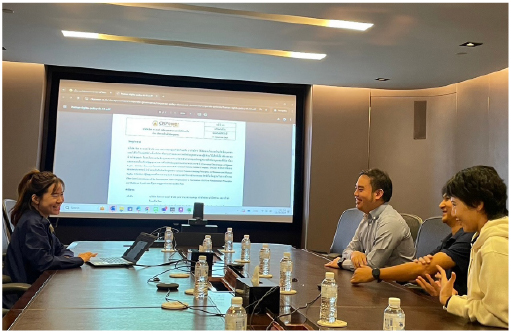
“Promotion of Responsible Business Practices and Respect for Human Rights” Training Course for Employees, Suppliers and Communities
To promote knowledge, understanding, and application of human rights principles in operations, CKPower organized human rights training for employees, suppliers, and communities around its power plants, with emphasis on enabling them to incorporate human rights practices into the foundation of their operations in a tangible manner.
Training for Employee
- 84.86% of CKPower’s employees completed human rights training (269 out of 317 employees).
- Three training sessions were conducted:
- Operational and Management Level – Organized on November 27, 2025
- Executive Level and Advisors – Organized on November 28, 2025
- Executive Level and Foreign employees – Organized on November 28, 2025
- Training topics covered the Human Rights Policy, international human rights standards, and integration of human rights practices in the organization.
Training for Suppliers and Communities
- CKPower provided human rights training to communities around power plants and suppliers to enhance their understanding of human rights throughout the value chain
- 100% of CKPower’s suppliers were informed of CKPower’s human rights policy and operational framework.
- 100% of CKPower’s high risk-tier 1 suppliers completed annual vendor self-assessment on human rights respect.
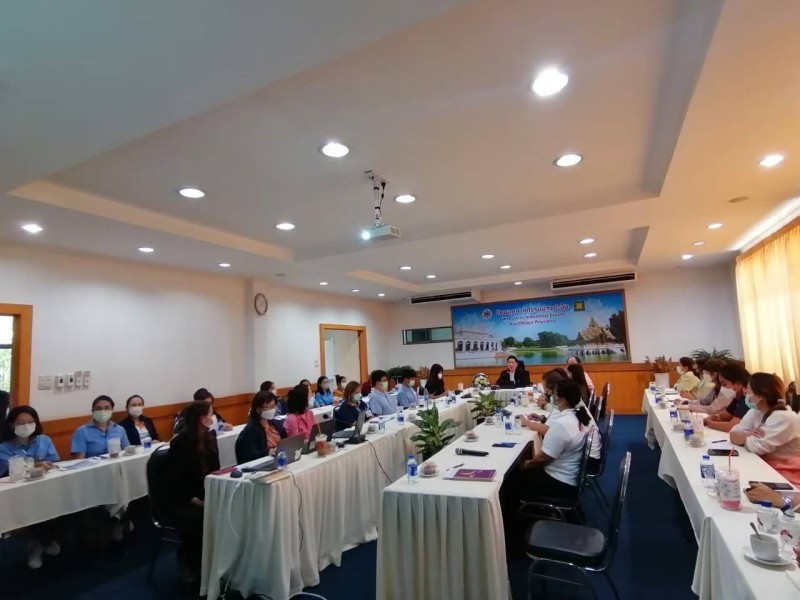
Human Rights Training for Communities Around Power Plants, Suppliers, and Relevant Government Agencies
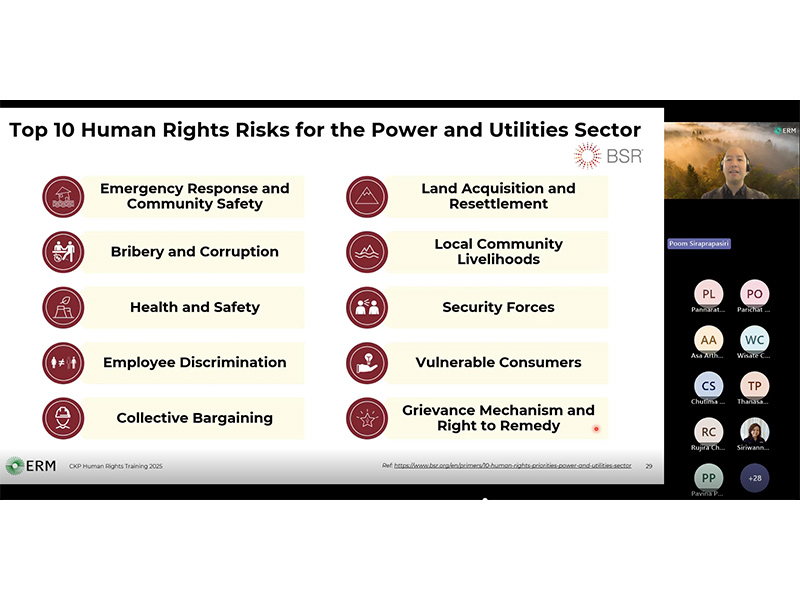
Human Rights Training for Executives and Employees
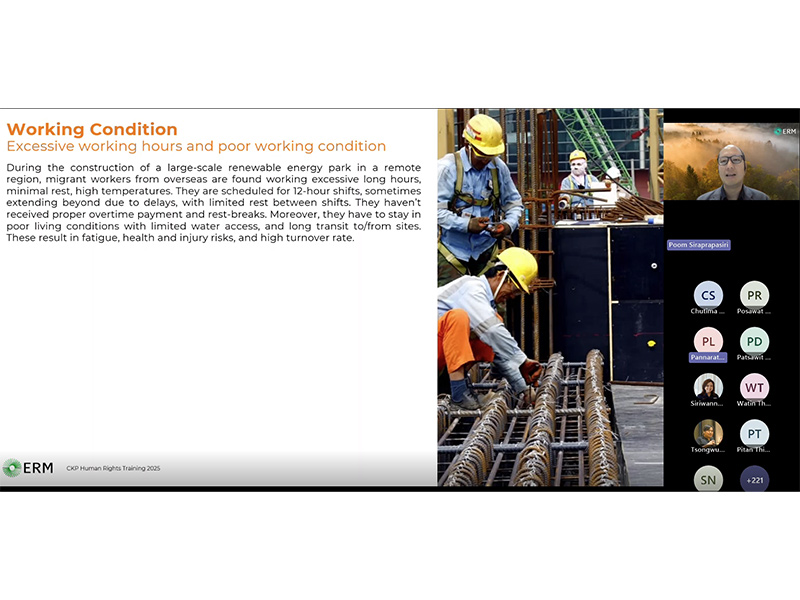
Human Rights Training for Communities and Key Suppliers Operating within the Company’s Project Areas
Sustainability report 2025