Stakeholder Engagement
Approach to Stakeholder Engagement (GRI 2-29)
CKPower recognizes the crucial role of stakeholder engagement in enhancing business operations and fostering long-term sustainability. To ensure a structured and transparent approach, CKPower has established a stakeholder engagement policy to guide the prioritization and understanding of stakeholder perspectives and expectations in the formulation of strategies and management approaches The Company conducted an annual review of stakeholder engagement activities and communication channels to ensure that all stakeholders have equal opportunities to participate, voice concerns, and contribute in a transparent and meaningful manner.
Stakeholder Engagement Process
CKPower's stakeholder engagement process consists of six key steps, as follows:


In relation to the process above, CKPower has identified eight key stakeholder groups:
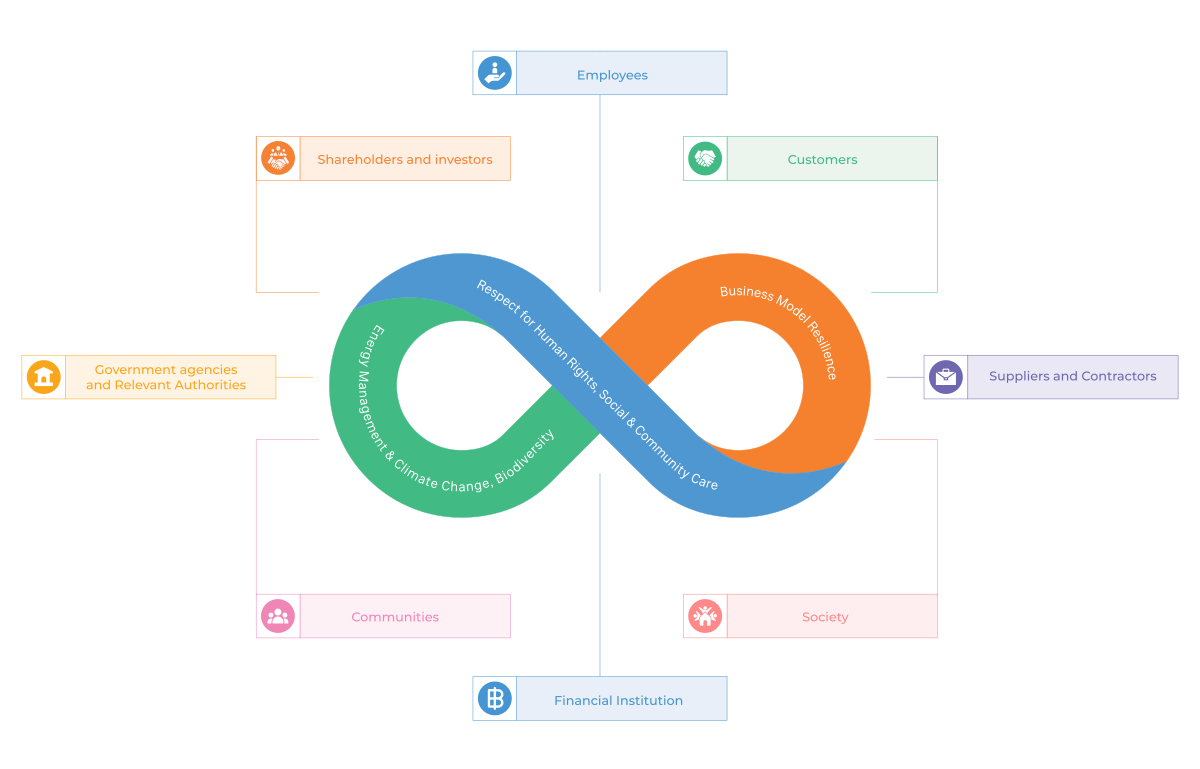
CKPower’s stakeholder engagement process is aligned with the AA1000 Stakeholder Engagement Standard (AA1000SES), ensuring a comprehensive approach to identifying stakeholders who may be positively or negatively impacted by its business activities across environmental, social, governance, and economic dimensions. The Company also integrates human rights considerations into its engagement approach and includes stakeholders involved in both core business operations and supporting activities throughout the value chain.
Stakeholders are further assessed based on their level of influence on CKPower’s operations and the degree of interdependence between CKPower and each stakeholder group, enabling the Company to effectively address material issues through appropriate engagement.
Scope of Impact of Sustainability Issues
| MATERIALITY TOPICS | SCOPE OF IMPACTS OF SUSTAINABILITY ISSUES | |||||||
|---|---|---|---|---|---|---|---|---|
| Internal | External | |||||||
| Employee | Shareholders and Investors | Customers | Government Agencies and Relevant Authorities | Suppliers and Contractors | Communities | Society | Financial Institutions | |
| Environmental Management | ||||||||
| Energy Management and Climate Change | ||||||||
| Biodiversity | ||||||||
| Social and Community Care | ||||||||
| Respect for Human Rights | ||||||||
| Human Capital Management | ||||||||
| Occupational Health and Safety | ||||||||
| Corporate Governance | ||||||||
| Risk and Crisis Management, Cybersecurity, and Data Privacy | ||||||||
| Innovation Management | ||||||||
| Business Model Resilience | ||||||||
| System Reliability and Availability | ||||||||
| Supply Chain Management | ||||||||
| Customer Relationship Management | ||||||||
Stakeholder Group
CKPower has identified eight key stakeholder groups, comprising employees, shareholders and investors, financial institutions, government agencies and relevant authorities, customers, suppliers and contractors, communities, and society. On an annual basis, the departments responsible for each stakeholder group assess the roles, interests, and significance of these stakeholders, and design appropriate engagement approaches, methods, and levels of participation. The Company also prioritizes stakeholders within each group to ensure that engagement activities effectively address relevant issues.
CKPower regularly reviews its stakeholder engagement approach to ensure that its practices remain aligned with the evolving business context and continue to effectively respond to stakeholder expectations.
Stakeholder Prioritization Results by Stakeholder Group in 2025
| Stakeholder Groups | Significance Level | Level of Engagement | |
|---|---|---|---|
|
Key Players
|
High Influence – High Interest |
Manage Closely Empowering and Collaboration: Promoting empowerment and collaboration to encourage stakeholders to play an active role in management processes. |
|
|
Context Setters
|
High Influence – Low Interest |
Keep Satisfied Consultation and Involvement: Two-way communication. |
|
|
Subjects
|
Low Influence – High Interest |
Keep informed Consultation and Involvement: Limited two-way communication |
|
|
Crowd
|
Low Influence – Low Interest |
Monitor Informing: One-way communication to provide information |
|
Actions in Responses to Stakeholder issues in 2025 (GRI2-26, 2-29)
| Stakeholder Management Results in 2025 | |||
|---|---|---|---|
| Issues of Interest/Expectations | Engagement Approaches and Frequency | Potential Benefits for Stakeholders | Actions in Response to Stakeholder Issues in 2025 |
|
|
|
|
| Stakeholder Management Results in 2025 | |||
|---|---|---|---|
| Issues of Interest/Expectations | Engagement Approaches and Frequency | Potential Benefits for Stakeholders | Actions in Response to Stakeholder Issues in 2025 |
|
|
|
Timely, accurate, and equitable disclosure of information through multiple communication channels, including:
|
| Stakeholder Management Results in 2025 | |||
|---|---|---|---|
| Issues of Interest/Expectations | Engagement Approaches and Frequency | Potential Benefits for Stakeholders | Actions in Response to Stakeholder Issues in 2025 |
|
|
|
|
| Stakeholder Management Results in 2025 | |||
|---|---|---|---|
| Issues of Interest/Expectations | Engagement Approaches and Frequency | Potential Benefits for Stakeholders | Actions in Response to Stakeholder Issues in 2025 |
|
|
|
|
| Stakeholder Management Results in 2025 | |||
|---|---|---|---|
| Issues of Interest/Expectations | Engagement Approaches and Frequency | Potential Benefits for Stakeholders | Actions in Response to Stakeholder Issues in 2025 |
|
|
|
|
| Stakeholder Management Results in 2025 | |||
|---|---|---|---|
| Issues of Interest/Expectations | Engagement Approaches and Frequency | Potential Benefits for Stakeholders | Actions in Response to Stakeholder Issues in 2025 |
|
Communities surrounding power plants in Thailand
Communities surrounding power plants in Lao PDR
|
|
|
|
| Stakeholder Management Results in 2025 | |||
|---|---|---|---|
| Issues of Interest/Expectations | Engagement Approaches and Frequency | Potential Benefits for Stakeholders | Actions in Response to Stakeholder Issues in 2025 |
|
Media
Educational Institutions
Local Authorities
Organizational Partners
|
Media
Educational Institutions
Local Authorities
Organizational Partners
|
Media
Educational Institutions
Local Authorities
Organizational Partners
|
Media
Educational Institutions
Local Authorities
Organizational Partners
|
| Stakeholder Management Results in 2025 | |||
|---|---|---|---|
| Issues of Interest/Expectations | Engagement Approaches and Frequency | Potential Benefits for Stakeholders | Actions in Response to Stakeholder Issues in 2025 |
|
Financial Institutions
Bondholders
|
Financial Institutions
Bondholders
|
Financial Institutions
Bondholders
|
Financial Institutions
Bondholders
|
The Company’s Value Chain (GRI 2-6)
CKPower places great importance on creating shared value throughout its electricity production and distribution process to efficiently meet stakeholders’ expectations across the entire value chain. Under the principles of Good Corporate Governance (GCG), the Company focuses on responsible supply chain management while fostering strong relationships and enhancing shared value with all stakeholders. This approach minimizes operational risks and mitigates potential impacts on the business.
CKPower’s value chain consists of both primary activities and supporting activities as follows:
Primary activities
Primary activities refer to activities that are directly involved in electricity generation and delivery to customers. These include:
1) Raw Material Management and Transportation : CKPower manages the procurement and management of key resources used in electricity generation, including water resources, solar energy, and natural gas, as well as the transportation of such resources to ensure sufficient and continuous supply for power generation. The Company places importance on cost efficiency, quality, and safety in transportation, storage, and resource management.
- The primary energy sources used in CKPower’s electricity generation include hydropower, solar power, and natural gas. In particular, Bangpa-in Cogeneration Power Plant relies on natural gas and treated water as key inputs and energy resources supplied by suppliers.
- The transportation and supply of natural gas and treated water are conducted through pipeline systems that are strictly regulated and controlled.
- The Company and its suppliers implement metering and monitoring systems in accordance with power purchase and supply agreements, while adhering to stringent safety standards to ensure stable and efficient energy transportation.
2) Electricity and Steam Production : CKPower generates electricity and steam from various types of power plants, which represents the core activity of the Company’s business. This includes power plant operations, system maintenance, production quality control, efficiency improvement, as well as environmental and safety management. Currently, CKPower invests in companies involved in electricity generation and supply from three types of power plants:
- Hydroelectric power plants
- Cogeneration power plants
- Solar power plants
The operation sites are located in Thailand and the Lao PDR, covering both renewable energy sources and fuel resources that can be efficiently managed for sustainable electricity production.
3) Electricity and Steam Supply : CKPower delivers electricity from its power plants to the electricity transmission systems of the national power utilities. This process includes transmission system management, maintaining power system stability, and coordinating with relevant authorities to ensure reliable and continuous electricity supply.
- CKPower generates electricity and industrial steam while ensuring the stability of transmission and distribution systems to support continuous energy delivery and effectively meet customer demand.
- Electricity is transmitted through the transmission lines and a substations, where voltage is stabilized before delivering power to consumers, ensuring system stability and safety.
- Industrial steam, produced by the Bangpa-in Cogeneration Power Plants, is conveyed through steam pipelines to industrial estate customers, with the pressure and temperature adjustments tailored to industry-specific requirements.
4) Electricity Delivery/Distribution : CKPower delivers and distributes electricity to customers and power utilities in accordance with long-term Power Purchase Agreements (PPAs). This process includes contract management, electricity metering and recording, billing, and customer services to ensure customer satisfaction and maintain long-term business relationships. The Company supplies electricity under long-term PPAs to industrial customers and government power utilities, including:
- Electricity Generating Authority of Thailand (EGAT)
- Provincial Electricity Authority of Thailand (PEA)
- Electricité du Laos (EDL)
5) Monitoring and Inspection of the Stability of Electricity after Delivery : CKPower monitors and evaluates electricity supply performance after delivery to ensure the stability and reliability of the power system. This process includes monitoring operational performance, verifying the quality of electricity delivery, and analyzing generation and consumption data to identify opportunities for efficiency improvement, problem resolution, and continuous service development. The Company also gathers customer feedback to further enhance operational performance and support continuous business improvement.
Supporting Activities
Supporting activities refer to activities that do not directly create value for customers but play a vital role in supporting and enhancing the efficiency of primary activities, ensuring that the Company’s electricity generation and supply processes operate effectively.
CKPower implements a centralized management system through a Shared Service Center (SSC), which enhances operational efficiency and ensures consistent quality management across all entities within the CKPower Group. This includes:
- Procurement System
- Internal Audit
- Financial & Accounting Management
- Human Resources Management
- Training & Development
- Customer Service Management
These supporting activities enable the Company to effectively support business expansion and respond to changes in the energy industry. These activities help reduce operational costs while strengthening the Company’s long-term competitiveness. CKPower has identified three key supporting activities as follows:
1) Centralized Management Center and Other Infrastructure : Activities that support the overall operations of the organization, including general management, strategic planning, risk management, corporate governance, and the management of organizational infrastructure. These activities ensure that operations are conducted efficiently and transparently.
2) Procurement, Production Input Management, and Selection of Equipment : The process of procuring materials, equipment, and services necessary for operations. This includes supplier selection, negotiation, contract management, and supplier performance evaluation to ensure the procurement of high-quality materials and services at competitive costs.
3) Financial Management, Investment Planning, and Financial Risk Management : Financial activities covering working capital management, financial planning, and the sourcing of funding for new investment projects. This also includes the management of financial risks such as foreign exchange, interest rate, and fuel price fluctuations to ensure strong financial liquidity and sustainable business growth.
Activities, Value Chain, Business Relationships, and Stakeholder Alignment Across the Value Chain (GRI 2-6, 2-29)
| 01 | 02 | 03 | 04 | 05 | |
|---|---|---|---|---|---|
| Activities | Raw Material Management and Transportation | Electricity and Steam Production | Electricity and Steam Supply | Electricity Delivery/Distribution | Monitoring and Inspection of the Stability of Electricity after Delivery |
| Primary Stakeholders |
|
|
|
|
|
| 01 | 02 | 03 | |
|---|---|---|---|
| Activities | Centralized Management Center and Other Infrastructures | Procurement, Production Factor Management, and Selection of Equipment | Financial Management, Investment Planning, and Financial Risk Management |
| Stakeholders |
|
|
|
Sustainability report 2025